Sunday, July 26, 2009

GWK Cultural Park


GWK or Garuda Wisnu Kencana Cultural Park, located at Ungasan, southern end of Bali, here is some description about the cultural park that i took from GWK cultural homepage http://gwk-culturalpark.com

Designed and built by Nyoman Nuarta, one of Indonesia's foremost modern sculptorhe Garuda Wisnu Kencana statue or GWK and its pedestal building will be standing 150 meters tall with its wings span 64 meters across. Made from more than 4000 tons of copper and brass, the statue is picturing Lord Wisnu, as the source of wisdom, riding on the back of the mythical bird Garuda as the manifestation of conscience toward Amerta, the perennial goodness.

The statue and its pedestal will be surrounded by more than 240 hectares cultural park which was once an abandoned and unproductive limestone quarry. The cultural park will provide attractions for both local and foreign visitors with supporting facilities such as Lotus Pond, Festival Park, Amphitheater, Street Theater, Exhibition Hall, as well as Jendela Bali The Panoramic Resto and souvenir shop. At present time, the statue of Wisnu, the statue of Garuda, and the hands of Wisnu have been placed temporarily in three different plazas within the park.
GWK Cultural Park is intended to educate, especially the young generations about the importance of preserving and cultivating world’s cultural heritage.


So dont miss this amazing cultural park on your next visit to Bali. For further information on facilities, daily events and other attractive art performances, please visit www.gwk-culturalpark.com.

Wednesday, March 25, 2009

The Day Of Silence

New Year’s day is perhaps is the oddest day in Bali, On this day, throughout the island , silence is observed and inactivity reigns supreme. Also called Nyepi Day, the Balinese Day of Silence, New Year’s Day falls on the day following the dark moon of the spring equinox, and opens a new year of the Saka Hindu era which began in 78 A.D.

On Nyepi day, which starts with sunrise, don’t expect to be able to do anything. You will have to stay in your hotel. No traffic is allowed, not only cars, but also people, who have to stay in their individual house. Light is kept to a minimum, radio tuned down, and no one works, of course.
Even love making, this ultimate activity of all leisure-timers, is not supposed to take place, nor even attempted. A whole day simply filled with the barking of few dogs, the shrill of insects and simple long, long quiet day in the calendar of this hectic island

Read more ...

Tuesday, March 17, 2009

The Galungan and Kuningan Festival

Among the many holidays in the Balinese 210-day calendar, the most prominent are undoubtedly those of Galungan and Kuningan ; the former on the Wednesday of the Dungulan week and the latter on the Saturday on the Kuningan week. Due to their frequency – roughly once every seven Gregorian months – these festivals are not celebrated as national holidays, but don’t try to do anything beetwen Penampahan Galungan (the day for the slaughter of the pigs that precede Galungan) and Manis Galungan, the day following it, or on the Friday preceding Kuningan; everything is closed. People go back to their village of origin to present offerings to their ancestors and village temples.

Unlike most Balinese festival which celebrate the particular anniversary of a temple, and are therefore scattered across the calendar, Galungan and Kuningan are all island holidays, everywhere, temples are all dressed up, with batik and white or yellow cloth wrapped around their individual shrines as sign that they are “occupied,” meaning the gods are visiting their descendants.

The ritual involved is a reminder of the strong ancestor’s cult aspect of the Hindu Balinese religion. When it took root in Bali, Hinduism instead of throwing away the older traditions as Christianity and Islam tended to do, integrated elements of ancestral beliefs and natural animism into its corpus, the rationale being that everything and every belief can be interpreted as “ray” or a manifestation of the “Ultimate Sun” of Surya (Siwa).


The ancestors do not come before being properly “invited”. They are expected to come on the Sugihan Jawa day when one makes offerings for the welfare of the world. The call is made in familiar language: “ Mai Jani mulih. Uba yang ngaenang banten. Mai delokin damuh-damuhe,” which means : “Please, come back home for a visit, we have prepared you food, please come and visit your descendants.”

This is all the more important for “dead” souls which have not yet undergone the whole cleansing process. If the dead is still buried in the cemetery, the soul is thought to be still hanging around nearby, provisionally entrusted to the God, the deity Prajapati. Thus it has to be handled with special care, and given the right punjung offering, lest it wreaks havoc among the living. But if the soul has been cremated and enshrined in the family temple, the danger is lessened and the chances are that its influence will be beneficent.

The language will change, though, to become more formal and religious, and the offering will be different, too: this time it will be a saji. The visit of the ancestors is expected to last until Kuningan. They will have feasted long enough and it will be time for them to go back to their realm of death. Another injunction will do “Go back over there to your abode of dead”. The shrines are then underessed and the temples return to quietness, waiting for another festival.

Source : Visitors Guide to Bali 2001/2002

Wishing a Happy Galungan and Kuningan Day to Ode and friends at Studio Kami, Dexno the master SEO and all my friends that celebrates it.

Tuesday, March 10, 2009

Bedugul


Bedugul area has the last remaining tropical forest on the island. The tranquil botanical garden of Kebun Raya Eka Karya in Bedugul are home to over 650 species of trees and a unique collection of ferns and orchid. Kebun Raya Eka Karya Bedugul also a great place for family gathering and outbound adventure.


Lake Bratan, one of the three lakes that make up the Bedugul resort area, offers water skiing and boating, but is better known for the Ulun Danu Temple. Built on the shores of the lake at Candi Kuning, it has eleven tiers of thatched-roof meru as well as an adjoining Buddhist stupa.


In the morning, when the air still clear and free of clouds, the drive leading south provides superb panoramic views over Kintamani, Mount Agung to the east, and down to the sea in the south.


Sunday, March 1, 2009

Tanah Lot Temple


The main attraction in Tabanan Bali, a famous seaside temple, located near the town of Kediri, Tanah Lot is arguable the most famous temple in Bali. Consisting of two-seven-tiered and three-tiered shrines and two pavilions, the temple is set a top on outcrop of rock jutting into the sea, and is accessible only during low tide.

According to the legend, as the famous priest Nirartha breathed his last, he suggested to the locals that the tiny island would be an excellent place to build a temple. “Tanah” means earth, and “Lot” means sea. The temple therefore symbolized the meeting point of natural and cosmic elements.


As a place for viewing spectacular sunsets in Asia, Tanah Lot has few equals. Every day at dusk, tourist throng the area to witness the magnificent silhoutte of the temple against the glowing horizon. The best view is from the cliff overlooking the temple.

Friday, January 30, 2009

Bajra Sandhi Monument


A monument built to commemorate Balinese heroes who fought against foreigns imperialism, is located at Puputan Margarana Square on Denpasar civics area Niti Mandala Renon.

Inside the monument we will find dioramas of Bali history from the beginning of pre historic era till recent time. At the lower level you'll find the library and photo exhibit room.

Below is an article about Bajra Sandhi Monument with very nice explanation about the monument and its building from wikipedia.org

Bajra Sandhi Memorial,the monument of Balinese People Struggle is located in Renon, Denpasar, Bali. The monument is located in a very wide area, there are several football fields around it.

Bajra Sandhi monument is the monument of Balinese People Struggle that was built to commemorate and honoring their heroes also as a symbol to preserve the soul of Balinese struggle from generation to generation and from time to time.

The data set of the monuments with quadrangular design Tri Mandala:

1. As Mandala is the main / most of the construction
2. As Madya Mandala is the orbit of the Great Mandala
3. Mandala that the snake is the most outside the orbit Madya Mandala

Building on the main building monuments in Mandala 3 levels:

* Utamaning Ground floor is 3 Mandala at the top of the space functions as a calm, quiet, serene to enjoy the atmosphere around the monument from a distance. Visitors can see the panoramic view from this place, Denpasar. At the time of the season, clearly visible Denpasar. To access this place must go through the rather high stairs.

* Mandala Madyaning Ground floor is 2 functions as a diorama of the 33 units. Floor 2 (two), as a place to display the thumbnails of the Balinese people struggle from time to time. The Dioramas are similar to Monas, Jakarta. But here only the struggle of the people of Bali. Start time of the kingdom, the inclusion of Hindu Majapahit, colonialism, wars of independence, until now.

Outside the tower in this room, there is a porch or terrace is open to enjoy the surrounding atmosphere.

* Mandala Nistaning ground floor of the main building is a monument, there is an information space, Library space, exhibition space, meeting rooms, administrative space, the building and toilets. The middle of the room there is a lake that is named as the navel Tasik, eight poles and the majestic rise of the Tapak dara.

Thursday, November 27, 2008

The Annual Bali Art Festival


This annual event usually held on midyear around June or July. All the art performances take place at Art Centre in Denpasar. For 30 days the festival presents arts and cultures performances from all regions of Bali. Actually not just from Bali, every year the festival would have guest performances from other provinces of Indonesia and foreign countries likes Japan, Australia, USA, etc.


So you don’t need goes around the island to find interesting art and cultures from every region of Bali, just come to the festival and you’ll find almost everything about the art and culture from all over Bali not to mention a bonus to see different cultures from other province in Indonesia and other countries.


What I like to see every time the event comes is the opening ceremonial that usually takes place at Bajra Sandi Monument in Renon Denpasar. Just like opening in sport event we will see the parade of the participants. In this festival the participants are represent all regions of Bali, other province of Indonesia and foreign countries.


The interesting parts of the parade that all the participants will wears their traditional outfit and performed a unique culture of their regions or countries. Unfortunately I could not watched the parade this year, but I still have some pictures from the opening ceremony parade last year.

Tuesday, November 25, 2008

The Day of Silence

New Year’s day is perhaps is the oddest day in Bali, On this day, throughout the island , silence is observed and inactivity reigns supreme. Also called Nyepi Day, the Balinese Day of Silence, New Year’s Day falls on the day following the dark moon of the spring equinox, and opens a new year of the Saka Hindu era which began in 78 A.D.

On Nyepi day, which starts with sunrise, don’t expect to be able to do anything. You will have to stay in your hotel. No traffic is allowed, not only cars, but also people, who have to stay in their individual house. Light is kept to a minimum, radio tuned down, and no one works, of course.
Even love making, this ultimate activity of all leisure-timers, is not supposed to take place, nor even attempted. A whole day simply filled with the barking of few dogs, the shrill of insects and simple long, long quiet day in the calendar of this hectic island.

Nyepi is religious event. Bali is a Hindu society, one that believes in the karmapala principle, according to which the dynamics of life and of Man’s individual fate is set in motion by “action”. Man is in the midst of a Samsara cycle of incarnation, each of which is determined by the quality of his actions (karma) in his former existence. His “ideal” is thus to put the system to rest, i.e., to control one’s actions, and thus to subdue one’s “demons”. Only in such a way can Man hope to achieve “deliverance” from his cycles of life (moksa) and eventually merge with the Oneness of the Void, the Ultimate Silence of Sunya.

The day of Silence is a symbolic replay of these philosophical principles. At he beginning of the year, the world is “clean”. The previous days, all the effigies of the gods from all the village temples have been taken to the river in long and colorful ceremonies. There they have been bathed by the Neptunus of Balinese lore, the god Baruna, before being taken back to residence in their shrines of origin. The day before Nyepi, all villages have also a large exorcist ceremony at the main village crossroad, the meeting place of the demons of the Bali world were let loose on the roads in a carnival of fantastic monsters, the Ogoh-ogoh.

The parade is held all over Bali after sunset. All the banjar neighborhoods and hundreds of youth associations make their own Ogoh-ogoh monsters. Some are giants from the classical Balinese lore, while others are guitarists, bikers or even AIDS microbes. All with fangs, bulging eyes and scary hair, illuminated by torches and with the accompaniment of the most demonic gamelan music (bleganjur) of the Balinese repertoire. They surge suddenly by the hundreds from every street, some more “horrible” than the others, each carried on the shoulder of four to thirty youths, jerking this way or that way so as to give the impression of a dance, or sudden turning in circle, much to the fascination of the spectators.

And, believe it, this is not small “procession”, it lasts for three to four hours, as if Bali has an inexhaustible pool of demons. No more than it gods and goddesses for sure. Thus, on Silence day, the world is clean and everything starts anew, with Man showing his symbolic control over himself and the “force” of the World. Hence the mandatory religious prohibitions of mati lelangon (no pleasure), mati lelungan (no traffic), mati geni (no fire), and mati pekaryan (no work).

Source : Visitors Guide to Bali 2001/2002

Friday, November 21, 2008

Git-git Waterfall

Git-git waterfall is one of the must see tourist site in Bali , I went to this beautiful and famous waterfall in last June with my family and friends, , almost every travel agent put Git - git on their travel schedule for west Bali area tour.

Here some of pictures i took in the Git - git waterfall, captured by my Canon S3iS, enjoy...

Sunday, November 16, 2008

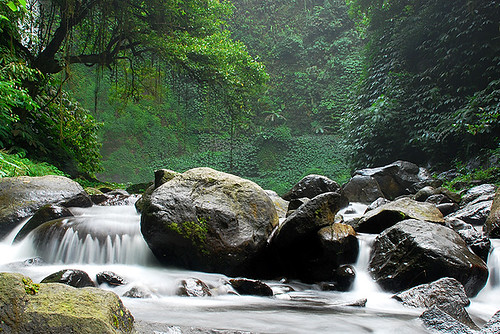
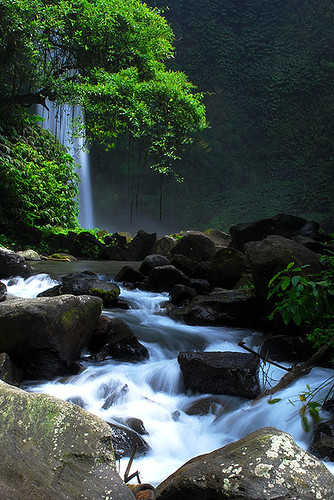
Nung nung Waterfalls

Another hidden beauty of Bali, just visited this place couple weeks ago on photo hunting trip with my friends. First things came in my mind that the waterfall would be just another tourist site like Git-git when my friends asked me to a photo hunting to a waterfall in Plaga


Surprisingly this beautiful waterfall is so quite we only met a tourist couple from Spain while on the site, They came because of their tour guide knows the place. Not well known likes Git-git waterfalls in Buleleng, might be because the waterfall is quite hard to reach.


To get to the waterfalls you have to walk down hill just like in Git-git waterfalls, the different is you need more effort because its steeper more than 45 degree. I had problems myself while walked back from the waterfalls, made me took a rest twice just to take a breathe like all the air in my lungs being sucked not to mention sore feet for couple days.


I personally not recommend older people and children’s to go there. But anyway the waterfall is beautiful to see. Personal thanks to Bli Wayan Suwitra and Bli Gede Mahayasa for brought me there.

Tuesday, November 11, 2008

Bali TreeTop

Bali TreeTop
Located in Kebun Raya / Botanical Garden at Bedugul Bali...
what a great place to test your skill and deal with your fear :)

The super girls Wida, Yuni and Sisca posing before action in "Black Lines"

Wida 15 metres above the ground

Fahmie up up and away...... :D

Yuni hanging 15 metres above the ground


Goin Up

Sisca in action
Lines up dude

Approach landing :)

Wanna Try ?

Saturday, May 31, 2008

Silent Serangan

Some of pictures i took at Serangan ..

Tuesday, May 20, 2008

S U N S E T

Feel the harmony of the nature, here in Bali... One of the great place in the world to watch Sunset..

Batu Belig Beach at Petitenget

A Surfer walked home at Kuta Beach

A couple at Kedonganan Beach south of Ngurah Rai Airport

A man walked home after fishing at Kuta Beach

A group of Tourist trying to captured the golden moment
at Kuta Beach

Sunset at Tanah Lot Temple

Sunset at Serangan

Another golden moment captured at Serangan